
The Hidden Cost of Fraud for Low-Margin Dropshipping Stores
Fraud costs low-margin dropshippers far more than the order they lose. Here's the real math behind chargebacks, false declines, and wasted hours and how to protect razor-thin margins.
If you run a dropshipping store, you already know the margins are tight. Industry data puts net dropshipping margins somewhere around 15–20% in a healthy store, and over half of store owners name thin margins as their single biggest challenge. So when fraud hits, it doesn't just sting it eats a disproportionate slice of a profit pool that was already small to begin with.
After more than 15 years helping merchants fight order fraud, here's the uncomfortable truth I keep coming back to: the headline loss from a fraudulent order is almost never the real cost. The chargeback amount is just the part you can see. Underneath it sits a stack of hidden costs fees, wasted labor, lost good customers, and platform penalties that quietly compound until they're bigger than the fraud itself.
This guide breaks down where those hidden costs actually live, why low-margin dropshippers feel them hardest, and how to think about prevention as a margin-protection decision rather than a security checkbox.
Fraud Doesn't Cost You a Dollar It Costs You Several
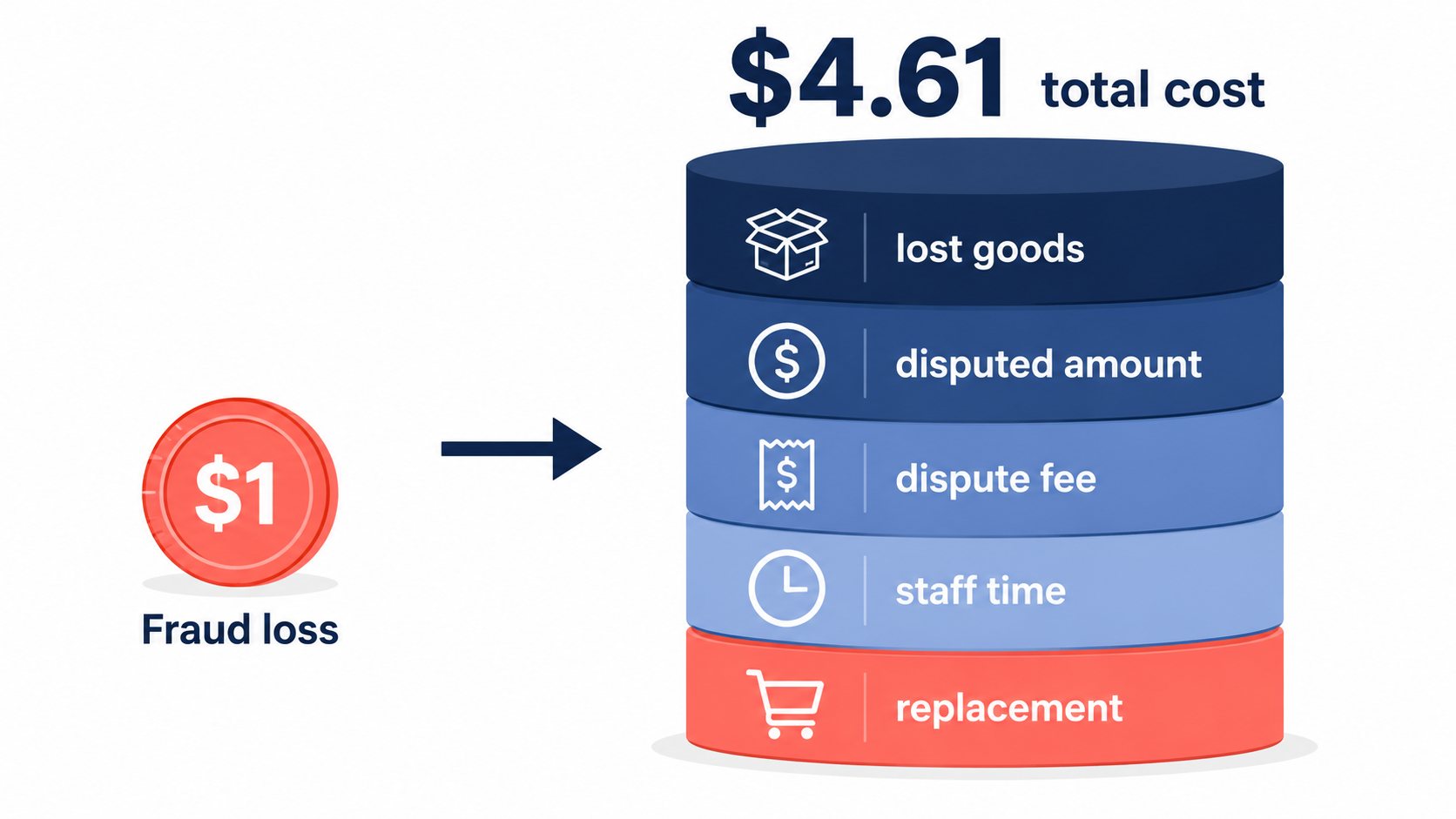
Let's start with the number that reframes everything. According to the LexisNexis True Cost of Fraud Study (2025 edition), every $1 of fraud now costs U.S. retail and ecommerce merchants about $4.61 in total up roughly 32% from $3.16 in 2022. That multiplier exists because a single fraudulent transaction triggers a chain of secondary costs: the lost merchandise, the disputed amount, processing and dispute fees, the staff time to investigate and respond, and the replacement of goods.
For a traditional retailer with healthy margins, a $4.61-per-dollar cost is painful but survivable. For a dropshipper running on a 15–20% net margin, it can be the difference between a profitable month and a loss. The fraud-cost multiplier and the thin-margin model collide in the worst possible way.
The Visible Cost: What You Already Knew
Most merchants account for the obvious losses, so let's name them quickly before moving to the part people miss.
As we cover in Dropshipping Chargebacks: Why They Hurt More and How to Prevent Them, a fraudulent order that results in a chargeback hits a dropshipper with three direct losses at once:
- The product cost you already paid your supplier and shipped the item, so the goods are gone.
- The disputed amount the bank pulls the sale value back out of your account.
- The dispute fee Shopify Payments and Stripe both charge around $15 per chargeback in 2026, refundable only if you win.
That's the "triple loss" that makes dropshipping fraud worse than fraud in an inventory-holding business. But it's still only the visible layer.
The Hidden Costs That Actually Drain Your Margin
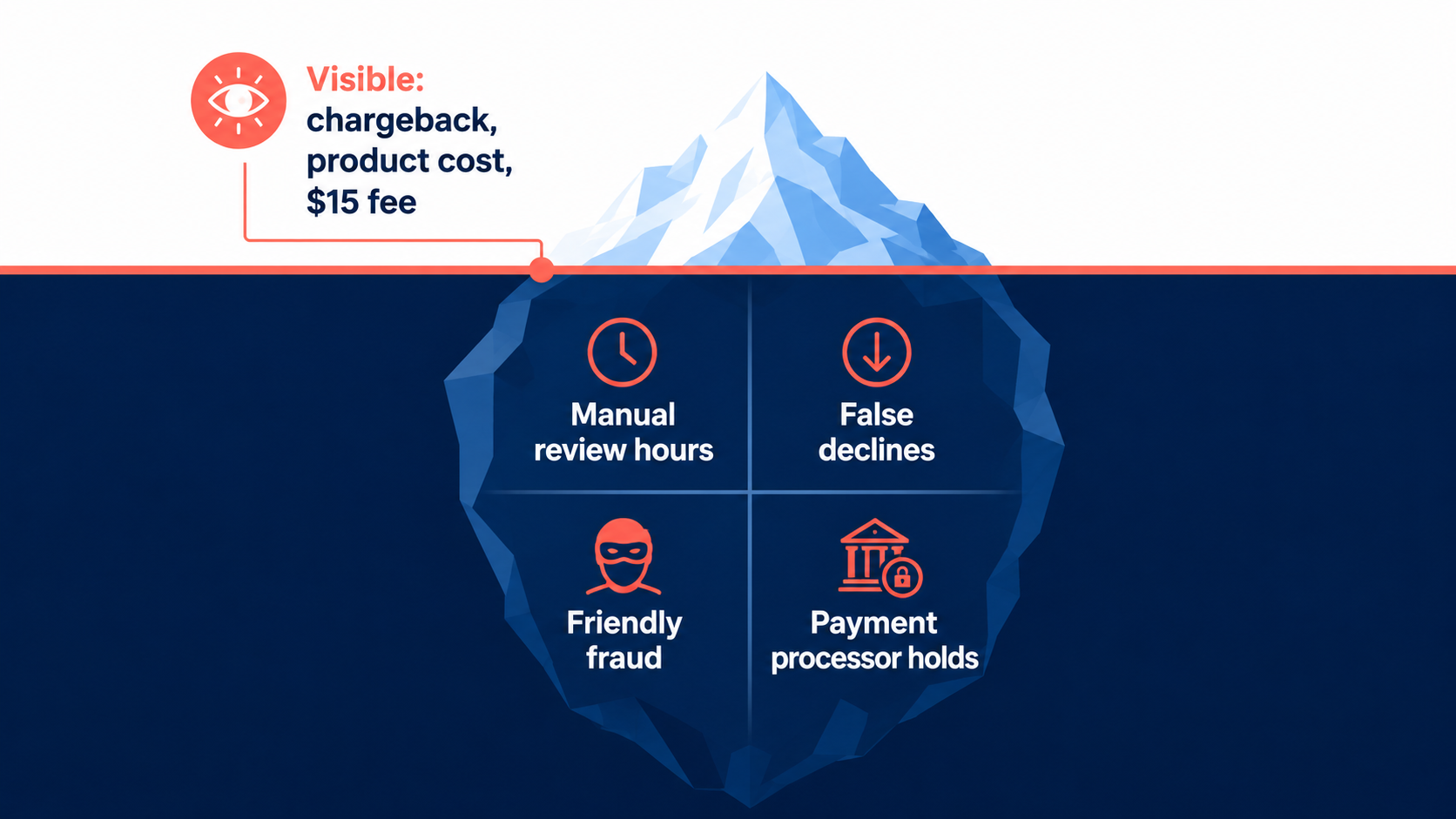
Here's where the damage compounds. These are the costs that rarely show up on a P&L line labeled "fraud," which is exactly why they're so dangerous.
1. The hours you burn on manual review
Every flagged order is a decision, and decisions take time. Reading the fraud analysis, cross-checking billing and shipping addresses, emailing or calling the customer, waiting for a reply multiply that by every suspicious order in a busy week and you've spent hours of your most valuable resource on unpaid fraud-fighting labor. For a solo or small-team dropshipping operation, that time has a real opportunity cost: it's time not spent on product research, marketing, or customer service that actually grows the store.
2. False declines the silent revenue leak
This is the cost almost nobody budgets for, and it's frequently larger than the fraud itself. When you tighten your filters too aggressively, you don't just block fraudsters you block real customers who happen to look risky. A first-time buyer placing a large order while traveling on a VPN can look identical to a criminal.
The scale here is genuinely startling. Research suggests false declines cost U.S. merchants on the order of $118 billion a year far more than the roughly $48 billion lost to actual ecommerce fraud. Nearly half of merchants estimate up to 5% of legitimate orders get wrongly declined, and the average store can lose up to 5.5% of annual revenue this way. Worse, around 40% of shoppers who get wrongly declined never come back. For a low-margin store that spent ad money to acquire that customer, a false decline means you paid the acquisition cost and got a lost lifetime customer in return.
So fraud imposes a cruel double bind: do nothing and lose money to chargebacks, or overcorrect and lose even more to false declines. The goal isn't maximum blocking it's accurate blocking.
3. Friendly fraud you can't easily contest
Not all chargebacks come from criminals. Friendly fraud where a real customer disputes a charge for an order they genuinely placed accounts for an estimated 60–80% of ecommerce chargeback losses. Dropshipping is especially exposed because longer shipping windows and third-party fulfillment create exactly the kind of expectation gap that fuels "I never got it" disputes. Each one still costs you the dispute fee, the staff time, and often the product.
4. Payment processor penalties and account holds
This is the existential hidden cost. Payment processors watch your dispute ratio closely, and the thresholds have tightened. Visa's VAMP program now flags merchants at a 0.9% dispute ratio in 2026 (down from 1.5% in late 2025), and crucially the newer metric folds in fraud signals many merchants don't track so a store sitting at 0.4–0.6% may have less cushion than it thinks. Once you drift toward the danger zone (often cited around 0.5–0.75%), processors can impose reserves, hold your funds, or freeze the account entirely. For a dropshipper, a frozen payment account isn't a fee it's the business grinding to a halt.
The Margin Math: One Fraud Order Erases Many Good Ones
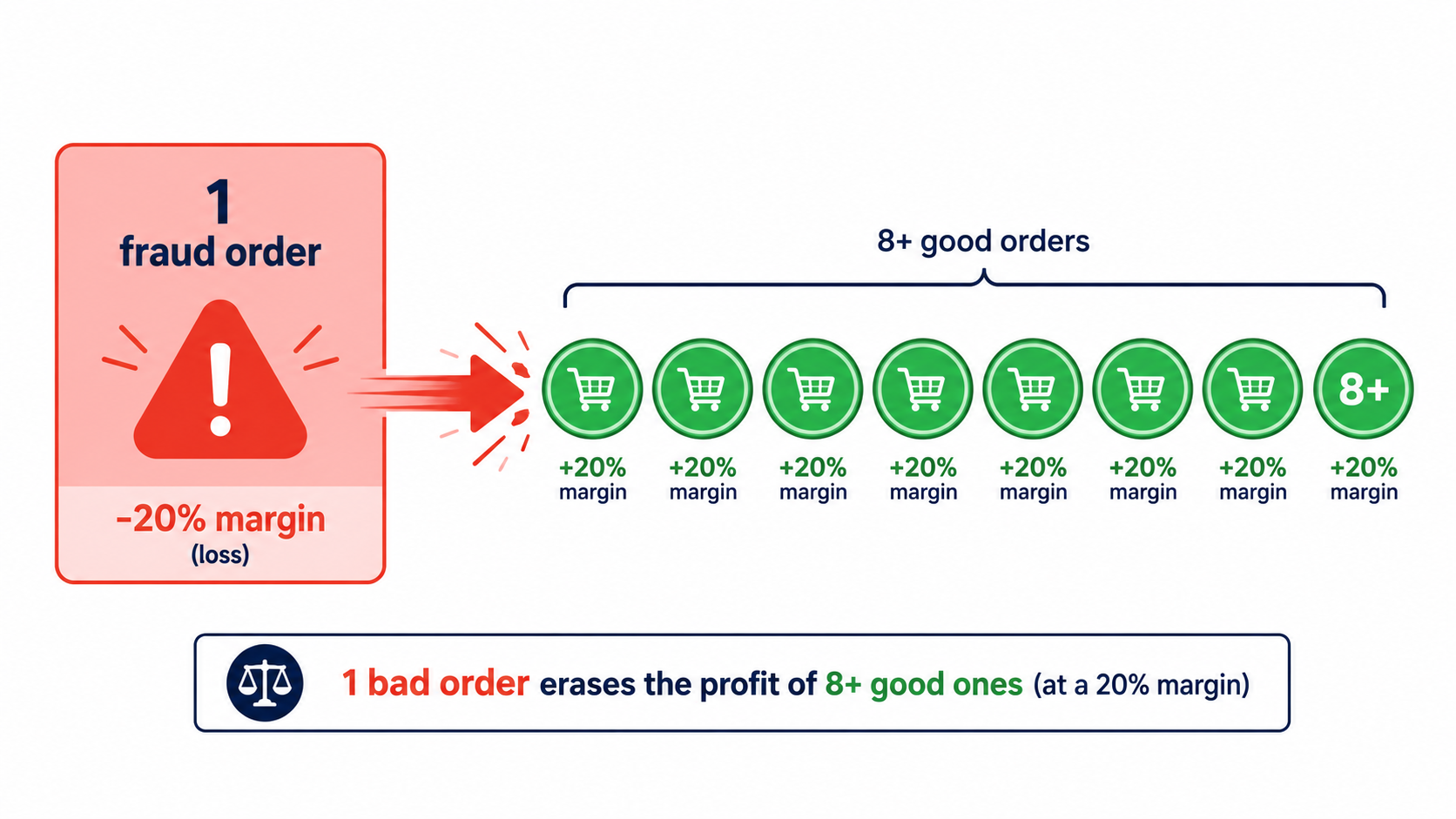
Here's the calculation that should drive every prevention decision. Imagine a store with a 20% net margin selling a $50 product. Each clean sale nets about $10 in profit. Now one fraudulent order goes through and turns into a chargeback:
- Lost product cost (say $20)
- Disputed amount returned to the bank ($50)
- Dispute fee (~$15)
- Plus the time you spent dealing with it
Even setting the labor aside, that single bad order can wipe out the profit from eight or more legitimate sales. That's the heart of why low-margin dropshipping is uniquely vulnerable: you have to win a long string of good orders just to absorb one bad one. The thinner your margin, the longer that string. At a 10% margin, the same fraudulent order could erase the profit from more than a dozen clean sales.
Prevention math runs the other way. Stopping a fraudulent order before you pay the supplier costs you essentially nothing no product, no dispute fee, no chargeback, no penalty risk. The asymmetry is the entire argument for catching fraud early.
How to Protect Thin Margins Without Strangling Conversions
Because the false-decline cost is so high, the answer is never "block more." It's "block more accurately, and do it earlier in the funnel." A few principles:
Stop fraud before checkout, not after. Reviewing flagged orders after they're placed means you're already partway down the cost chain. Screening risky traffic before it reaches checkout catching stolen-card patterns, bot activity, and anonymized sessions earlier is what protects the supplier payment you haven't made yet.
Separate the three causes of chargebacks. Shipping delays, product-quality complaints, and outright fraud are three different problems with three different fixes. Tools and apps can meaningfully reduce the fraud slice, but they won't fix a slow supplier or a misleading product photo so pair fraud screening with honest delivery timelines, clear billing descriptors, and proactive tracking emails to shrink the friendly-fraud slice too.
Tune thresholds to your real risk profile. Lowering an auto-block threshold catches more fraud but risks more false declines; raising it does the reverse. Review your flagged orders periodically and adjust rather than setting it once and forgetting it.
Whitelist legitimate privacy tools. If you block anonymizing traffic like proxies, commercial VPNs, and TOR, make sure to allow genuine privacy services such as Apple's iCloud Private Relay otherwise you turn a fraud control into a false-decline machine.
A dedicated fraud-prevention layer is where this gets practical. An app like Browsify App focuses specifically on the fraud slice: it scores visitor risk, detects proxy/VPN/TOR sessions, fingerprints repeat offenders, and can automatically hold or block high-risk traffic before an order is ever placed with an iCloud Private Relay allowance built in to protect real Apple users. It won't fix supplier delays or product mismatches, and it's not a promise to stop 100% of fraud but for the slice that is preventable, catching it before you pay your supplier is the whole game. There's a free tier if you want to see how your own traffic scores before committing.
Frequently Asked Questions
How much does fraud really cost beyond the order amount? Industry research (LexisNexis, 2025) estimates U.S. retail and ecommerce merchants pay roughly $4.61 in total cost for every $1 of fraud, once you include lost goods, dispute fees, labor, and replacement costs. The order amount alone understates the true damage.
Are false declines really worse than fraud? In aggregate, yes. Studies estimate false declines cost U.S. merchants around $118 billion annually versus roughly $48 billion in actual fraud. That's why over-aggressive blocking is its own expensive mistake you lose good customers and the revenue they would have generated over time.
Why are low-margin stores hit harder? Because each fraudulent order has to be absorbed by the profit from many clean sales. At a 20% margin, one bad order can erase the profit from eight or more good ones; at 10%, it's even more. Thin margins leave almost no buffer.
Can I prevent fraud without hurting conversions? Largely, yes if you focus on accuracy rather than volume. Screen risky traffic before checkout, tune your thresholds to your actual data, and whitelist legitimate privacy tools so you're stopping criminals, not customers.
Will fraud prevention stop chargebacks completely? No tool stops every chargeback, because some disputes come from shipping delays or friendly fraud rather than criminal activity. Fraud prevention reduces the criminal slice; clear communication and reliable fulfillment reduce the rest.
Final Thoughts
For a low-margin dropshipper, fraud is rarely a single, visible loss. It's a stack of hidden costs dispute fees, wasted hours, false declines, friendly fraud, and the ever-present risk of a payment hold that compounds against a profit pool that was thin to start with. Run the margin math even once and the conclusion is hard to escape: when one fraudulent order can erase the profit from eight or more good ones, prevention isn't an expense. It's the cheapest line item you have.
Catch fraud early, block accurately rather than aggressively, and close the expectation gaps that breed disputes. Do that consistently, and you stop hidden costs from quietly eating the margin you worked hard to earn.
This article is for general educational purposes and reflects common e-commerce fraud-prevention practices; it isn't legal or financial advice. Statistics cited reflect publicly reported industry research and may change over time always confirm current Shopify features and your payment processor's policies before making decisions.
Related Guides
- Chargeback Protection — How to prevent chargebacks and protect your dispute ratio before it costs you.
- Stop Fake Orders on Shopify — The complete guide to identifying and blocking fraudulent orders.
- Payment Fraud Prevention — Stop stolen-card fraud before it turns into a costly chargeback.
- Automatic Fraud Blocking — Set up rules that protect your store 24/7 without manual review.