
What Is an IP Address and Why It Matters for Store Security
A plain-English guide to IP addresses for Shopify store owners what they are, what they reveal about a visitor, how accurate the signals really are, and where they fit in fraud prevention.
If you've ever looked at a fraud report, a fraud-prevention app, or a list of "high-risk countries" in your store analytics, you've run into the term IP address. It sits quietly behind almost every security and fraud decision your store makes yet most merchants never learn what it actually is or how much to trust it.
After 15+ years working in fraud prevention, I've found that store owners who understand IP addresses make far better decisions: they stop over-blocking real customers, they know which signals are reliable, and they recognize when a "suspicious" order genuinely deserves a second look. This guide explains IP addresses in plain English, what they can and can't tell you, and where they fit in a sensible store-security setup. It's educational by design no jargon you don't need.
What Is an IP Address, Really?
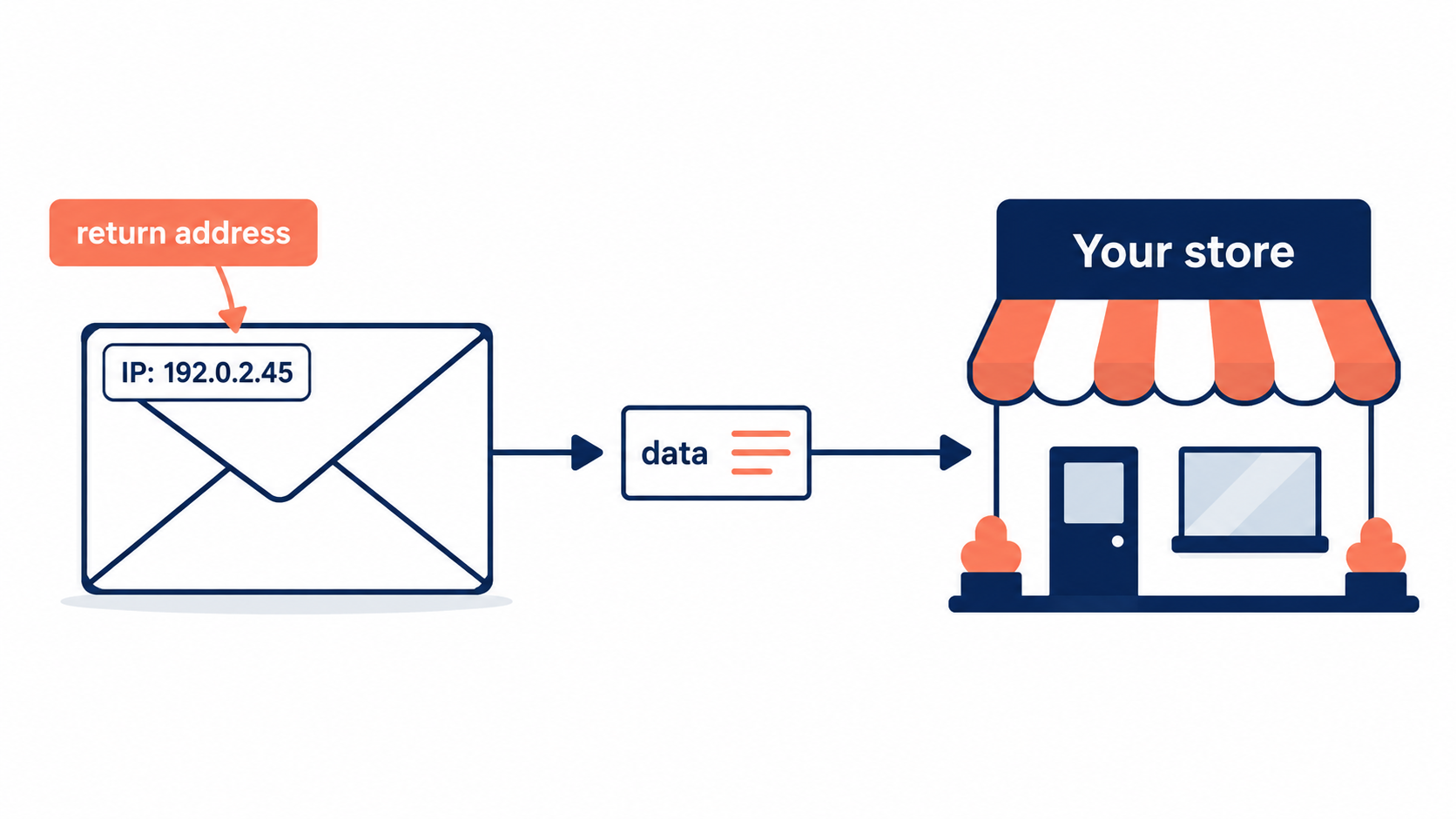
An IP address (Internet Protocol address) is a unique numerical label assigned to every device that connects to the internet your customer's phone, their laptop, your store's server. Think of it like a return address on an envelope: it tells the internet where to send the data a device requests, so that when someone loads your product page, your store knows where to deliver it.
Every visitor to your Shopify store arrives with an IP address attached to their connection. Your store, and any security tools you use, can read that address and learn a few useful things from it.
You'll see IP addresses in two formats:
- IPv4 the classic format, four numbers separated by dots, like
192.0.2.45. The world is slowly running out of these. - IPv6 the newer, much longer format made of letters and numbers, created because there aren't enough IPv4 addresses left for all the world's devices.
You don't need to memorize either format. What matters is what the address can reveal.
What an IP Address Can Tell You About a Visitor
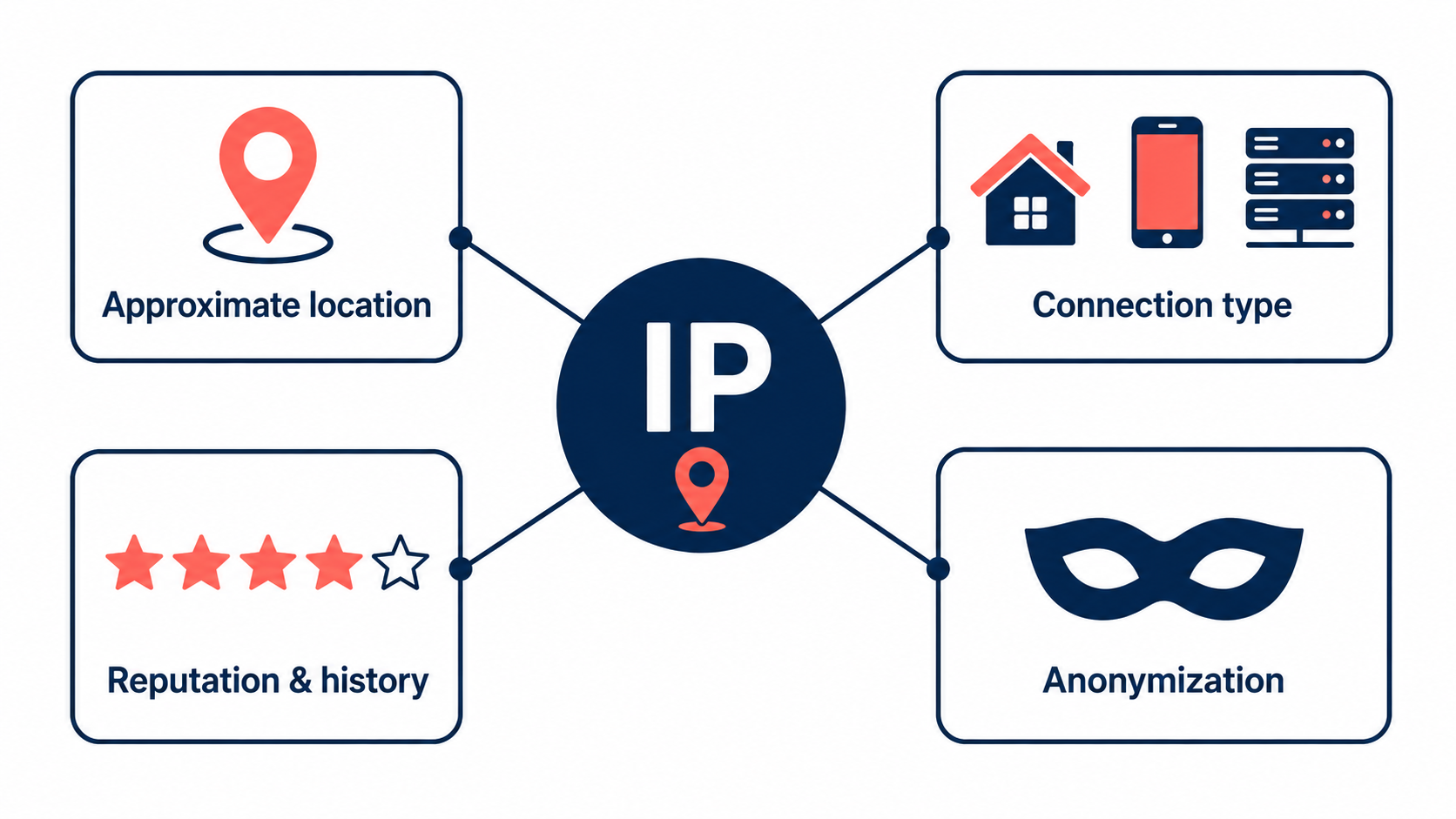
An IP address isn't just a routing label it carries signals that are genuinely useful for security. Here's what you can reasonably learn:
Approximate location. IP geolocation maps an address to a place. This is the basis for the "high-risk countries" view many merchants watch.
Connection type. Every IP belongs to a network a home internet provider, a mobile carrier, or a datacenter. A normal customer browses from a residential or mobile connection. Traffic coming from a datacenter is a meaningful flag, because real shoppers rarely browse from a server farm. In fact, IP type has become one of the first signals serious fraud systems check Stripe, Shopify, and Cloudflare all evaluate IP origin as a primary risk signal.
Reputation and history. An IP can carry a track record. If an address (or its surrounding network block) has a history of abuse, spam, or fraud, that reputation follows it. This is how blocklists and risk scores get a head start before a visitor does anything on your site.
Anonymization. IP analysis can often reveal when someone is hiding behind a proxy, VPN, or TOR connection tools disproportionately associated with fraud (though, importantly, also used by privacy-conscious legitimate customers).
How Accurate Is IP Data? (The Honest Answer)
Here's where many merchants go wrong: they treat IP location as gospel. It isn't, and knowing its limits will save you from blocking good customers.
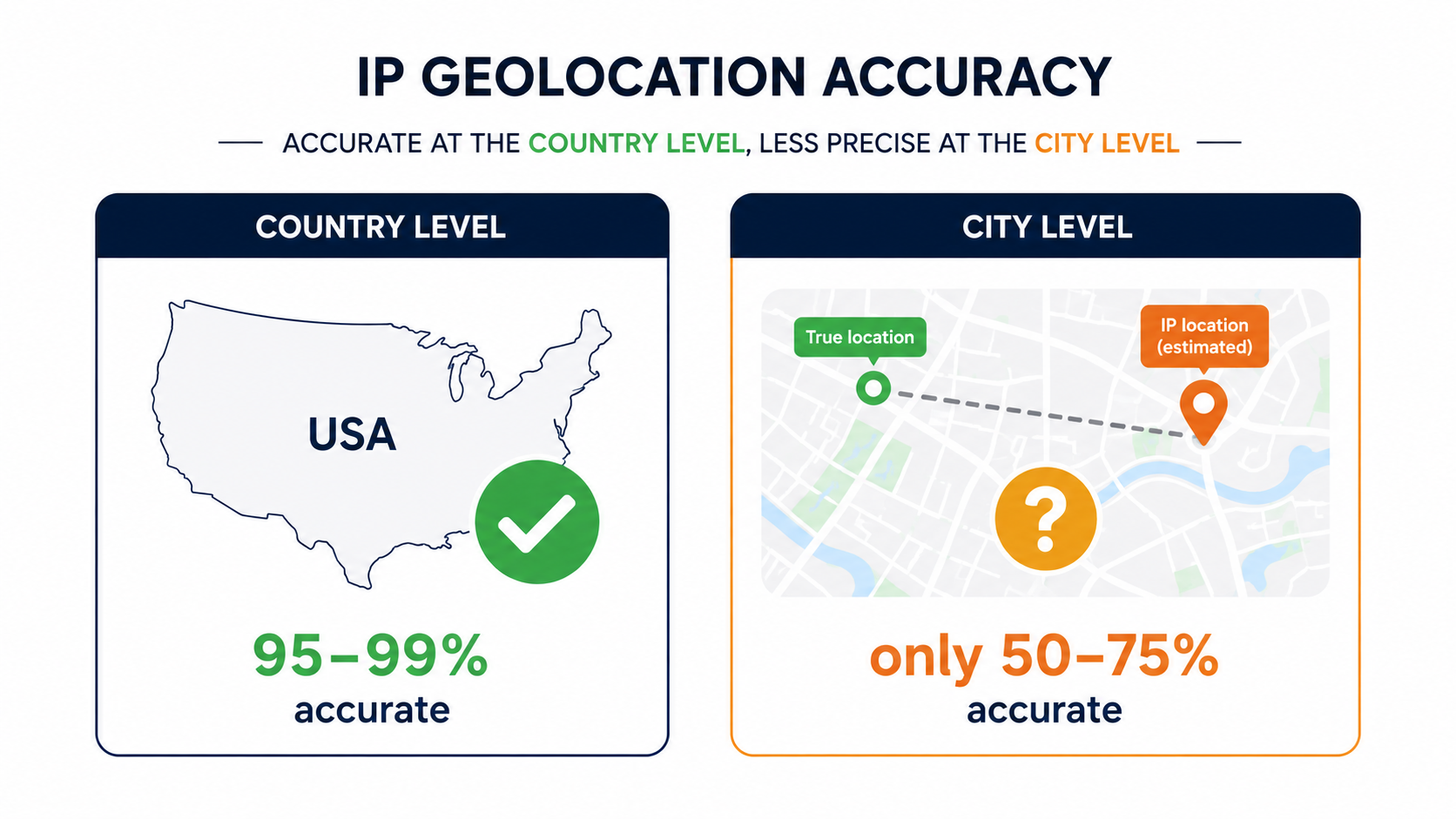
Country-level accuracy is high. Identifying the country an IP belongs to is reliable, typically in the 95–99% range. So when a tool says an order originated from a particular country, you can mostly trust that.
City-level accuracy is much shakier. Pinpointing the exact city is only accurate somewhere in the range of 50–75%, and it varies a lot by region, ISP, and connection type. A customer's IP can place them a city or even a state away from where they really are. So treating a city mismatch as proof of fraud is a mistake.
Anonymization tools blur everything. When a visitor uses a VPN or proxy, their IP reflects the server's location, not theirs. And the landscape is shifting fast: research in 2026 found that residential proxies evaded IP reputation feeds in a striking share of malicious sessions, which means IP reputation alone is no longer enough to catch sophisticated fraud.
The takeaway: IP data is a strong signal, not a verdict. It's excellent at the country level and as one input among many but it should never be the only thing deciding whether to block an order.
Why This Matters for Your Store's Security
So why should a busy store owner care about any of this? Because IP signals quietly power several everyday security decisions:
Blocking obvious bad actors. If you're getting hammered by traffic from a specific country you don't sell to, or from datacenter IPs that no real shopper would use, IP-based rules let you block that traffic before it costs you anything.
Spotting risky orders. When an order's IP country disagrees with the card's issuing country and the shipping destination, that disagreement is one of the classic fraud red flags. The IP is doing real work there.
Detecting hidden visitors. IP analysis is the foundation for catching proxy, VPN, and TOR users the people most likely to be hiding their true location for a reason.
Avoiding false positives. This is the flip side, and it's just as important. Because IP location isn't perfect and because plenty of legitimate customers use VPNs or Apple's iCloud Private Relay for privacy good security means not auto-blocking on a single IP signal. The goal is accuracy, not aggression.
Where IP Fits in a Layered Approach
The most important mental model to take away is this: IP is one layer, not the whole wall. On its own, an IP address can mislead you. Combined with other signals the device's fingerprint, the visitor's behavior, the order's payment details, and a risk score that weighs everything together it becomes genuinely powerful.
This is exactly how modern fraud detection works. No single signal decides anything; a scoring system blends many signals into one risk verdict, so a weak or ambiguous IP signal gets balanced against everything else rather than triggering a block by itself. We go deeper on how those scores are built in Understanding Risk Scores: How Fraud Detection Actually Works, and on hidden visitors in Proxy, VPN, and TOR: How Fraudsters Hide and How to Block Them.
If you want to see how IP signals show up in practice, a store-security app like Browsify App surfaces them directly: it reads visitor IPs to flag high-risk countries, detect datacenter and anonymized connections, and feed those signals into a risk score with an iCloud Private Relay allowance so privacy-minded Apple customers aren't caught by mistake. It's a useful way to learn what your own traffic looks like before you decide what to act on. (More on configuring this in our VPN & Proxy Blocking guide and Fraud Risk Scores guide.)
Frequently Asked Questions
Can an IP address identify a specific person? No. An IP address identifies a connection, not an individual, and it's an anonymized identifier rather than personal data like a name or email. Many people can share one address (everyone on the same office or home network), and addresses change over time.
Is it safe to block an entire country by IP? It can be, if you genuinely don't sell or ship there country-level IP accuracy is high (95–99%). Just be aware that travelers and VPN users from that country's diaspora may be caught, so block deliberately.
Why does a customer's IP show the wrong city? Because city-level geolocation is only 50–75% accurate and is affected by ISPs, mobile networks, and VPNs. A city mismatch alone is not evidence of fraud verify before acting.
Should I block all VPN and proxy traffic? Not blindly. These tools are associated with fraud but are also used by ordinary privacy-conscious shoppers. The safer approach is to score the risk and whitelist legitimate privacy services like iCloud Private Relay rather than auto-blocking everything.
Does IPv6 change anything for store security? The core ideas are the same IPv6 is just a newer, longer address format created because IPv4 ran out of space. Good security tools handle both.
Final Thoughts
An IP address is one of the quietest but most useful signals in your store's security toolkit. It can tell you roughly where a visitor is, what kind of connection they're using, whether that connection has a bad reputation, and whether they're trying to hide all before they place an order.
But its power comes with a caveat: it's a signal, not a sentence. Country data is trustworthy; city data is rough; anonymization muddies the picture; and the smart move is always to combine IP with other signals rather than acting on it alone. Understand that, and you'll make sharper security decisions catching more of the bad traffic while keeping your real customers flowing through.
This article is for general educational purposes and reflects common e-commerce security practices; it isn't legal or financial advice. IP geolocation accuracy and fraud-signal techniques evolve over time always confirm current capabilities of any tool before relying on it.
Related Guides
- VPN & Proxy Blocking — How to block fraud traffic from anonymizing services without losing real customers.
- Visitor ID & Browser Fingerprinting — How Visitor ID works and why it's more reliable than IP blocking.
- Fraud Risk Scores — How IP and other signals combine into one risk verdict.
- Stop Fake Orders on Shopify — The complete guide to identifying and blocking fraudulent orders.